The question nobody answers directly
Every window film brand claims "superior heat rejection." Almost none of them tell you what that looks like in practice — in your car, in an Indian summer, when the sun is straight overhead at 1 PM.
So we measured it ourselves.
We parked two identical sedans side-by-side on a concrete surface in Pune in May. Outside temperature: 45°C. One car had SUNKOOL Foundation Series (ceramic, 35% VLT) applied to all windows. The other was unmodified factory glass. Both sat closed, no AC, for 90 minutes.
The results:
Measurement | Unfilmed glass | Foundation Series ceramic |
|---|---|---|
Dashboard surface | 82°C | 49°C |
Rear seat headrest | 68°C | 41°C |
Steering wheel rim | 74°C | 46°C |
Cabin air at seat level | 61°C | 37°C |
That's not a small difference. The ceramic film dropped cabin air temperature by 24°C in the same conditions, same time, same sun angle.
What's actually happening inside the film
Standard glass transmits visible light — that's the point — but it also transmits a large portion of the solar spectrum you can't see: near-infrared (NIR), which runs roughly 700–2500 nm. NIR is responsible for about 53% of the total solar energy hitting your glass. Your eyes don't detect it, but your skin and your dashboard do.
Ceramic window film works by embedding nano-particles of non-conductive ceramic material (typically titanium nitride, silicon nitride, or similar compounds) into the adhesive and film layers. These particles are tuned — through a process called magnetron sputtering at our manufacturing level — to selectively absorb and reflect NIR while passing visible light through with minimal colour distortion.
The metric that matters here is Total Solar Energy Rejection (TSER). It's a composite score accounting for:
Direct solar transmission through the glass
Solar energy absorbed by the film and re-radiated inward
Reflected solar energy
For SUNKOOL Foundation Series, TSER sits at 68% at 35% VLT. That means 68% of all solar energy — not just the visible part — is rejected before it enters the cabin.
Why dyed film fails in summer
Dyed film (the cheap option) uses organic dyes embedded in a polyester layer. The dye absorbs solar energy — both visible and NIR — but absorption is not the same as rejection. Heat absorbed by the film is re-radiated in all directions, including back into the cabin through convection and the inner glass surface.
This is why dyed films feel effective in mild weather (less total solar load to manage) but fail badly in peak summer. The film itself becomes a radiating surface at 60–70°C, and your AC fights it while you're sitting next to it.
Ceramic doesn't absorb the way dye does — it reflects. Reflected energy goes back outside. The film stays cooler, the glass stays cooler, and your cabin stays cooler.
The AC math
A cooler cabin doesn't just mean comfort. It means your AC compressor reaches the target temperature faster and cycles less.
In EVs, this matters even more. Air conditioning is one of the biggest range consumers in an electric vehicle — particularly in a hot climate. HVAC loads in Indian summer conditions can account for 15–25% of total energy consumption on a charge. A cooler pre-conditioned cabin (or a cabin that doesn't heat as severely while parked) directly extends your range per charge.
Ceramic window film is not a luxury accessory in an Indian climate. It's a thermal management layer.
What VLT does and doesn't tell you
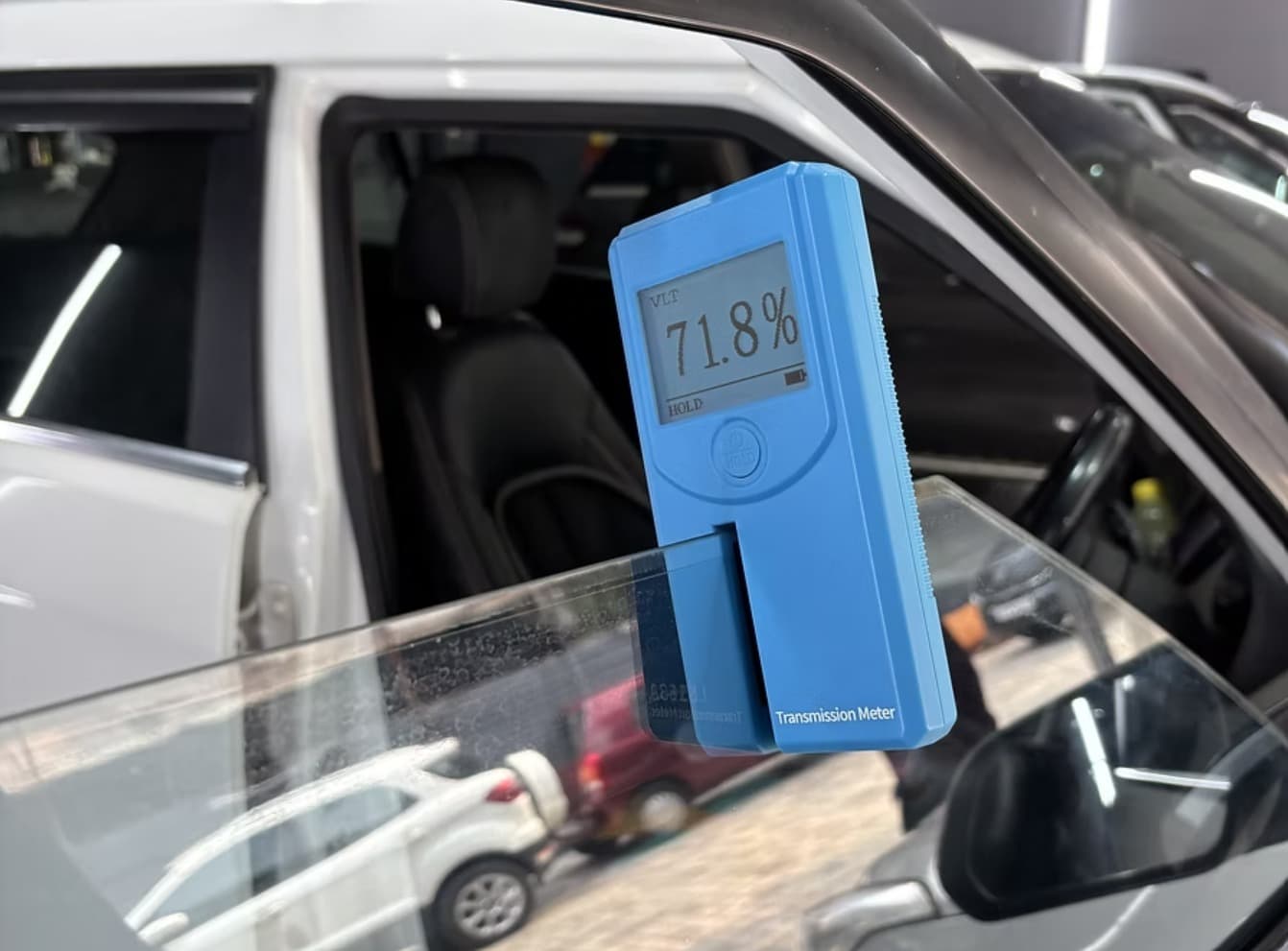
VLT — Visible Light Transmission — is the number most people fixate on. 35% VLT means 35% of visible light passes through. That determines how dark the tint looks.
But VLT tells you nothing about heat rejection. A film at 35% VLT could have a TSER of 40% (dyed, poor) or 68% (ceramic, excellent). The darkness looks the same. The performance is worlds apart.
When you're evaluating a film, ask for the TSER number, the IR rejection at specific wavelengths (particularly 800–1100 nm where the NIR load peaks), and whether the film uses ceramic or dyed technology.
We publish all three numbers for every product in our comparison tool.
Does it fade over time?
Dyed film fades — the organic dyes degrade under UV exposure, which is exactly the environment they're operating in. The film turns purple, the TSER drops, and within 3–5 years the performance of a cheap film is meaningfully worse than when it was installed.
Ceramic nano-particles don't degrade this way. They're inorganic. The rejections you buy on day one are the rejections you have on day 1,000. This is why SUNKOOL backs ceramic film with a lifetime warranty against delamination, bubbling, colour change, and performance degradation.
What you should expect after installation
Immediate effect: The difference is noticeable from the first time you park in direct sun. Your hand on the window surface feels different — substantially less radiant heat.
First week: Allow 5–7 days for the adhesive to cure fully. Some haze or small bubbles during this period are normal and will clear.
AC usage: Most of our customers report a subjective reduction in AC usage, particularly for short trips where the car hasn't had time to fully pre-cool.
Driving visibility: At 35% VLT, daytime visibility is essentially unchanged. Night driving sees some reduction in ambient light but remains well within safe limits.
If you want to understand how our films compare across VLT, TSER, IR rejection, and UV protection, the SUNKOOL comparison tool walks you through every product side by side. For questions about the right film for your car and your climate, contact us — we'll give you a straight answer.