The short version
In India, the Motor Vehicles Act and the Supreme Court's 2012 order establish minimum Visible Light Transmission (VLT) requirements for car windows:
Windshield (front glass): Minimum 70% VLT
All other windows (side, rear): Minimum 50% VLT
Films that reduce transmission below these thresholds are technically illegal to use on public roads. Factory-tinted glass from the manufacturer is typically calibrated to comply; aftermarket films must also comply, and it is the responsibility of the vehicle owner — not the installer — if the combined VLT (glass + film) falls below the limit.
This is not a grey area. The Supreme Court issued a clear directive in Avishek Goenka vs. Union of India, and it remains in force.
Why this rule exists and why it's contested
The stated rationale was safety: heavily tinted windows reduce visibility for law enforcement to see into vehicles, creating a security risk. The practical effect was to ban the darkly tinted windows that were common on high-end cars at the time.
The ruling drew criticism from the medical community and from researchers who pointed out that:
UV exposure through glass is a significant health risk. Glass that meets 70% VLT requirements still transmits a substantial portion of UV-A radiation, which is linked to skin damage and some cancers — particularly for people who drive long hours.
High VLT does not mean low IR rejection. A film at 70% VLT can still reject 60–70% of solar heat. Heat rejection and darkness are independent variables in modern ceramic film.
Despite petitions, the VLT thresholds have not been revised as of 2026.
What VLT means in practice
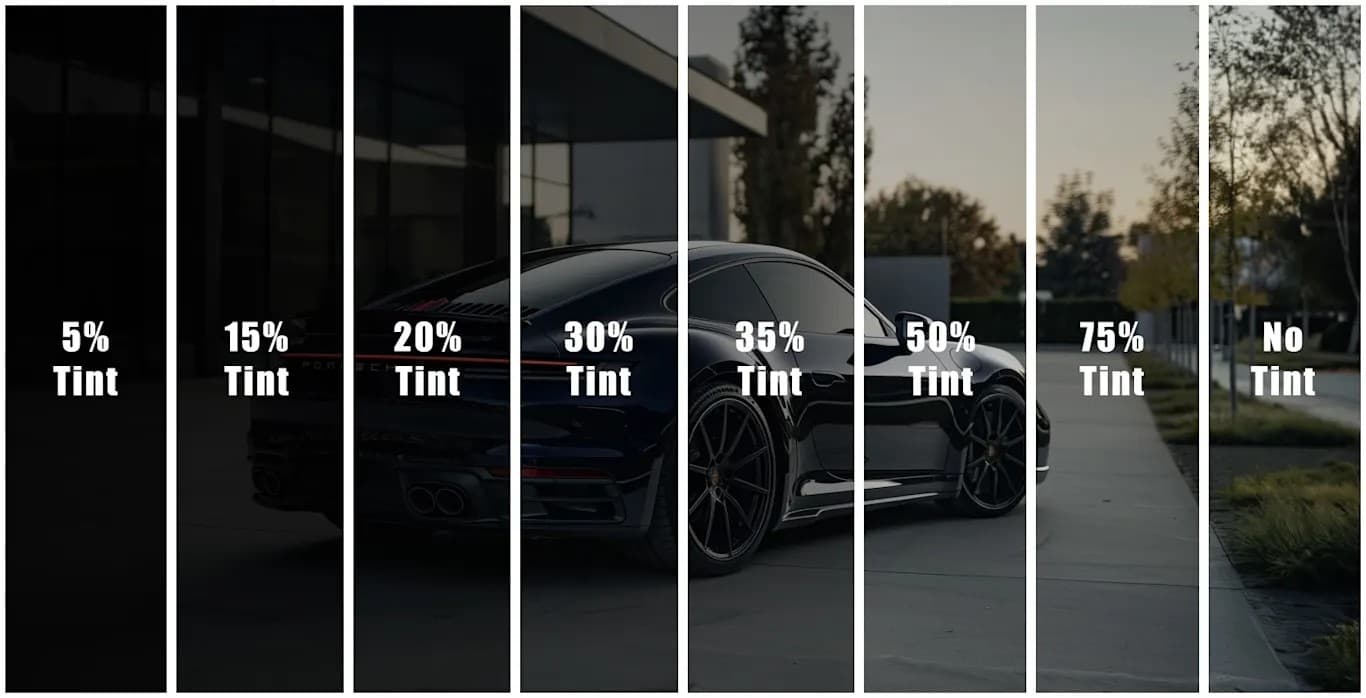
VLT is the percentage of visible light that passes through a surface. The higher the number, the lighter the film.
Most factory glass is between 72–80% VLT. A film at 70% VLT on the windshield means very little visible tinting — the glass looks essentially clear. On side windows with a 50% VLT requirement, you have more range; a film can appear moderately tinted and still comply.
The critical calculation: combined VLT = glass VLT × film VLT
Example: If your factory side glass is 75% VLT and you apply a film at 70% VLT, the combined result is 0.75 × 0.70 = 52.5% — compliant. But apply a 65% VLT film to the same glass and you get 0.75 × 0.65 = 48.75% — non-compliant.
This is why you cannot simply look at a film's VLT specification in isolation. You need to know your factory glass VLT and calculate the combined result.
SUNKOOL's compliance position
Every SUNKOOL film is tested and documented for its VLT percentage. Our product range for the Indian market is designed with compliance in mind:
Film | Nominal VLT | Application | Compliant on typical factory glass |
|---|---|---|---|
Foundation 35 | 35% | Side & rear windows | Yes (on 75%+ factory glass) |
Foundation 50 | 50% | All windows | Yes |
Signature 50 | 50% | All windows | Yes |
Signature 70 | 70% | Windshield, all windows | Yes |
Ultra Edge 50 | 50% | All windows | Yes |
Ultra Edge 70 | 70% | Windshield, all windows | Yes |
When SUNKOOL installers apply film, they check your specific vehicle's factory glass VLT before recommending a product. We don't sell compliance claims — we verify them.
Note: The 35% VLT products are sold for rear and rear-side windows only, where many vehicles have factory-tinted glass that, when combined with the film, still meets the 50% threshold. This must be verified per vehicle.
Enforcement in practice
Enforcement is inconsistent across India. Some states — Maharashtra, Karnataka, Delhi — have run periodic enforcement campaigns with VLT meters at checkpoints. Other states see minimal enforcement.
This doesn't change the legal position. If your vehicle is stopped and the combined VLT is below threshold, the potential consequences include:
A challan (fine) — currently up to ₹1,000 for a first offence, higher for repeat
A requirement to remove the film before the vehicle can be driven
In commercial vehicle cases, potential licence implications
The risk is low in many cities and very real in others. We advise compliance regardless of local enforcement intensity, both for legal protection and because compliant films offer excellent performance.
UV protection: the exemption argument
Some vehicle owners apply films primarily for UV protection on medical advice — particularly for passengers with photosensitivity conditions or those undergoing specific treatments. The 2012 ruling acknowledged this as a valid exemption, requiring documentation:
A certificate from a registered medical practitioner
Approval from the relevant state RTO
The vehicle must carry the documentation at all times
This process is cumbersome and the exemption is narrowly applied. Do not assume a medical certificate alone is sufficient without the RTO approval step.
PPF and regulations
Paint Protection Film (PPF) is applied to the exterior paint surface and does not affect glass VLT. PPF is not regulated under the window tint rules and does not require any special approval.
If you're considering PPF for paint protection alongside window film for heat and UV, these are independent applications with no regulatory interaction.
What to do before buying film
Get your factory glass VLT measured. Your installer should do this. If they don't, ask why.
Calculate combined VLT for each window position. Windshield must meet 70%, all others 50%.
Ask for documented film specifications. SUNKOOL provides lab-tested VLT data for every product.
Keep your installation documentation. Our certificates include the film product, the VLT, and the vehicle details — useful if you're ever challenged at a checkpoint.
The SUNKOOL regulations page has state-by-state enforcement notes updated regularly. And if you want a compliance check for a specific film on your specific vehicle, contact us directly.
The law is clear, the technology is excellent within those constraints, and the performance difference between a cheap non-compliant film and a compliant ceramic film from a serious brand is not what most people expect. Compliance doesn't mean compromise.
